Home > Plasma > Surface activations
Introduction to plasma surface activation
Plasma surface activation treatments modify materials through two main mechanisms: the creation of a reactive layer or the introduction of chemically active functional groups and radicals. These modifications enable a durable bond between various materials, such as metals, plastics or ceramics, by creating direct interactions at the molecular level. This approach not only circumvents thermal limitations, but also improves the strength and uniformity of the bond across the interface.
There are two main types of activation using PECVD:
• Activation using a noble gas
• Activation using a reactive gas
Noble gas
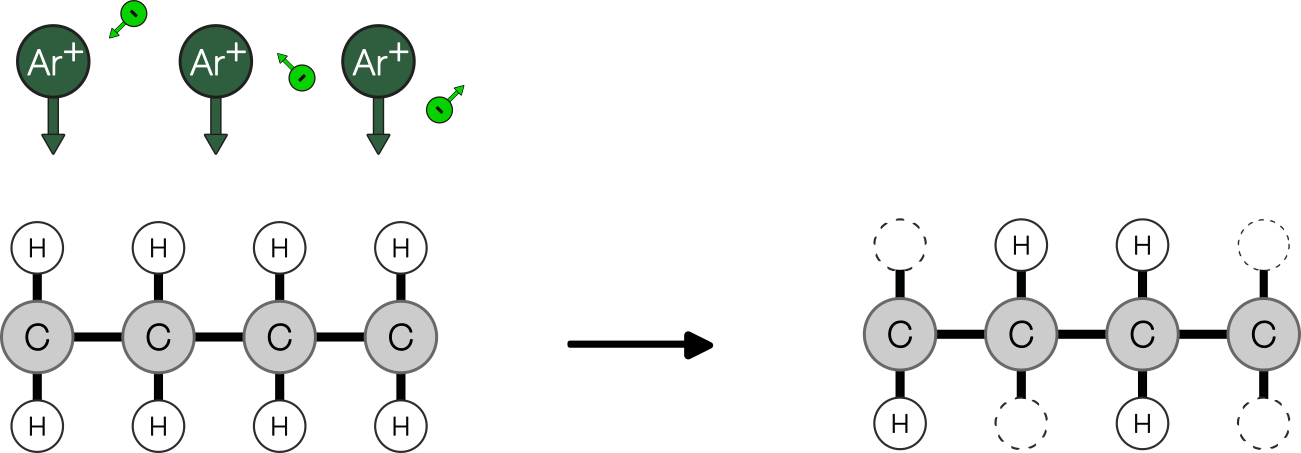
A standard method involves using argon plasma. A plastic substrate (for example) is placed in a vacuum chamber filled with argon. When sufficient electrical voltage is applied inside the chamber, some of the argon atoms are ionised, creating plasma.
The resulting argon ions are driven to regain their electrical neutrality and seek to combine with electrons.
Their high levels of reactivity allow them to extract electrons from molecules on the surface of the substrate.
The polymer’s molecular bonds are broken and single electrons are left on the surface of the plastic.
This creates a chemically active layer, preparing the material for better adhesion or other reactions.
Common results with this solution: Cleaning, light etching and cross-linking.
Reactive gas
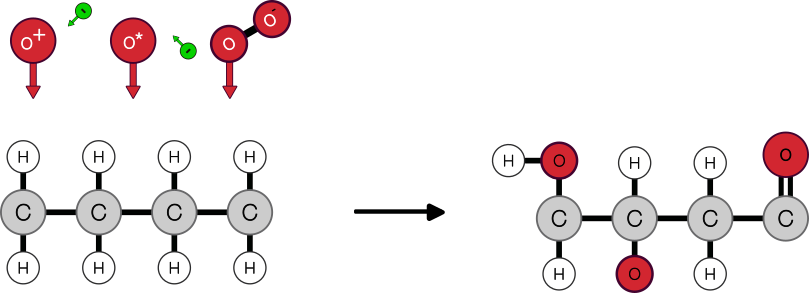
Reactive gases are widely used in plasma treatments to modify material surfaces, enabling strong bonding between dissimilar materials.
Oxygen plasma is a common example, where oxygen gas is ionised to create a reactive environment. Oxygen plasma generates new functional groups on the surface of plastics or polymers.
These groups increase surface energy, making the material more hydrophilic and more reactive.
Common results with this solution: improved adhesion, functionalisation and cleaning.
Plastics processing
When treating plastics with plasma, it is essential to take into account the dynamic mobility of polymer chains and their specific characteristics.
Plasma treatment of polymers depends on the crystallinity, cross-linking, functional groups, etc. of the polymer.
For successful plasma treatment, understanding of the surface chemistry and the desired result is important.
That is why at Isytech, we have extensive experimentation capabilities in our laboratory in order to optimise each process.
Laboratory