Home > Industries > Transport and defence
Activation prior to bonding, printing or painting
Coatings do not adhere well to plastics (PP, PEEK, POM etc.) because these materials are often hydrophobic and have low surface energy. Surface preparation is therefore necessary to improve adhesion. The treatment also ensures that the surface complies with PWIS/LABS free standards.
Common methods include adhesion primers, which can sometimes be polluting.
Plasma is a more environmentally friendly alternative.
In addition to plastics, it is possible to improve the surface of many materials using PECVD treatment.
Fluoropolymer etching
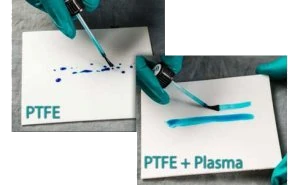
Tetra Etch, or Tetra Etching, is a chemical surface treatment for PTFE (Teflon) that makes its surface polar and bondable.
It is now possible to avoid this process by using plasma etching technology.
The reaction activates the PTFE to enable optimal bonding, whilst avoiding the constraints associated with corrosive and toxic products.
Industrial constraints are radically reduced.
Processing of composites
Plasma treatment is now an essential technique in the preparation of composite materials prior to bonding or impregnation.
When it comes to bonding, the main challenge with composites — particularly those based on carbon fibres or epoxy resins — lies in their low surface energy, which makes it difficult for adhesives to bond effectively.
Plasma treatment helps to clean the surface of any organic contamination, thereby increasing the surface energy.
For impregnation, plasma plays an essential complementary role. It promotes the uniform penetration of the resin into the fibre reinforcement. This reduces the presence of voids and dry spots, two major defects that weaken the final part. Plasma-treated parts thus exhibit a better fibre/matrix interface, resulting in improved mechanical properties.